The 60-Second Answer
Prebiotics are non-digestible plant fibers, like inulin, FOS, and MOS, that pass through your dog's stomach and small intestine intact, then become food for the beneficial bacteria living in the colon. The best prebiotics for small breed dogs are chicory root, dandelion greens, Jerusalem artichoke, banana, asparagus, burdock root, oats, and pumpkin. For small breed dogs, who are disproportionately prone to digestive sensitivity and breed-specific enteropathies (a general medical term for any disease, damage, or malfunction of the intestinal tract, specifically the small intestine), prebiotics are not optional. They are the daily fuel that keeps the gut microbiome diverse, the immune system regulated, and the gut lining intact. A well-formulated prebiotic plan, fed alongside a fresh whole-food diet, is the single most underrated lever in small breed wellness.
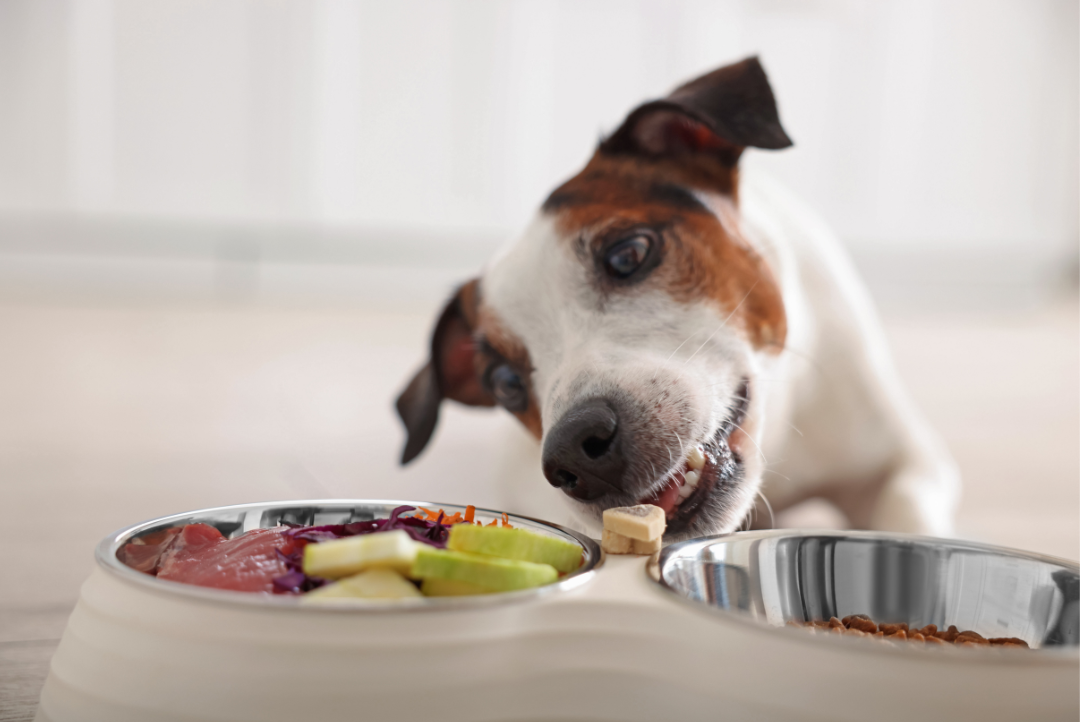
Small breed Jack Russell next to a bowl of fresh prebiotic foods including chopped vegetables.
Why Small Breed Dogs Need a Different Conversation About Gut Health
If you live with a Yorkie, a Maltese, a Mini Schnauzer, a Mini Poodle, a Chihuahua, a Shih Tzu, or any of the toy and small breeds, you already know something the average dog parent doesn't: small dogs are not just little versions of big dogs. Their digestive tract is a different physiological landscape entirely, and the science backs that up.
A peer-reviewed review of digestive sensitivity across body sizes concluded that small breeds have a number of breed-specific GI conditions. Yorkshire Terriers, Miniature Pinschers, Miniature Poodles, Maltese, and Miniature Schnauzers were specifically named as more vulnerable to chronic GI issues. Yorkshire Terriers in particular have a breed-specific form of chronic enteropathy (Yorkshire Terrier Enteropathy, or YTE) that researchers have linked to a distinct dysbiotic microbiome signature - a marked overgrowth of Clostridium sensu stricto 1, Escherichia-Shigella, and Streptococcus, alongside a depletion of beneficial Bacteroides and Prevotella.
Translation, in plain English: the small breed gut is more reactive, less tolerant, and more easily knocked out of balance - and that imbalance has downstream consequences far beyond a runny stool.
This is the first installment in a three-part series I've written for the small breed community I work with every day. We'll start with prebiotics - the most misunderstood and most foundational of the "biotics" - before moving on to probiotics and postbiotics. By the end of this series, you'll have a complete framework for the trifecta that drives gut, immune, skin, joint, and even neurological health in your small dog.
What Are Prebiotics, Exactly? (And Why They're Not Probiotics)
Prebiotics are a specific type of plant-derived fiber that selectively feeds beneficial gut bacteria.
Let me clear up the most common confusion I hear in consultations.
Prebiotics are the food. Probiotics are the bacteria. Postbiotics are the byproducts that beneficial bacteria produce when they eat prebiotics.
The International Scientific Association for Probiotics and Prebiotics (ISAPP) defines a prebiotic as "a substrate that is selectively utilized by host microorganisms conferring a health benefit." In practice, that means a prebiotic is almost always a specific type of plant-derived fiber - soluble, fermentable, and indigestible to your dog's own enzymes.
Your small dog's stomach acid won't break it down. Their pancreatic enzymes will ignore it. It travels untouched through the small intestine until it reaches the colon - the densest microbial real estate in their body - where the beneficial bacteria do break it down, ferment it, and turn it into health-promoting compounds.
The most studied prebiotic fibers in canine nutrition are:
Inulin - a long-chain fructan abundant in chicory root, Jerusalem artichoke, and dandelion
Fructooligosaccharides (FOS) - shorter-chain fructans in bananas and asparagus
Mannanoligosaccharides (MOS) - derived from yeast cell walls, well-studied in canine kibble formulations
Beta-glucans - soluble fibers from oats and mushrooms that double as immunomodulators
Pectin - found in apples and the membranes of citrus fruit (for dogs, apples without seeds)
Resistant starch - from cooled cooked white rice, green bananas, and certain potatoes
Each of these feeds a slightly different population of beneficial bacteria, which is why a diverse prebiotic intake - not a single isolated fiber - produces the best microbiome outcomes.
The Gut–Immunity Connection: Why This Conversation Matters Beyond the Bowl
Here is the statistic I want every small breed parent to internalize: roughly 70% of your dog's immune system lives in the gut-associated lymphoid tissue (GALT), the immune cells embedded along the intestinal wall.
What that means is straightforward and a little startling. Your small dog's ability to fight off infection, modulate allergic responses, regulate inflammation, recover from antibiotics, and maintain healthy skin and coat is physically dependent on the conversation happening every day between their gut microbes and their immune cells.
That conversation is mediated by short-chain fatty acids (SCFAs) - primarily butyrate, acetate, and propionate - which are produced when beneficial bacteria ferment prebiotic fibers. SCFAs are not a side effect. They are the primary signaling molecules. Butyrate, in particular, is the preferred fuel source for the colonocytes (the cells lining the colon) and a powerful regulator of inflammatory pathways.
When the prebiotic supply is rich and consistent, the microbiome stays diverse, SCFA production stays high, the gut lining stays tight (more on "leaky gut" in Part 3), and immune signaling stays calibrated.
When prebiotics are scarce - as they often are in dogs eating a 100% kibble diet - beneficial bacteria starve, opportunistic species expand, SCFA production crashes, and the entire downstream cascade goes off the rails.
What Dysbiosis Looks Like in Small Breeds - and Why You Probably Already Know
The technical term for an imbalanced microbiome is dysbiosis. Texas A&M's Gastrointestinal Laboratory offers a clinically validated Canine Microbiota Dysbiosis Index (DI) - a quantitative PCR assay that measures the abundance of seven key bacterial taxa. A DI score above 2 indicates significant dysbiosis with high specificity.
But you don't need a lab to recognize the signs. In small breeds, dysbiosis often looks like:
Chronic soft stool, intermittent diarrhea, or alternating diarrhea and constipation
Excessive flatulence (and not the funny kind - the consistent kind)
Bad breath that isn't dental in origin
Itchy paws, recurrent ear infections, hot spots, or yeasty skin
Anal gland issues that keep returning
Tear staining and chronic eye discharge (especially in white-coated breeds)
Picky or erratic appetite
Anxiety, reactivity, or "off" behavior - yes, the gut–brain axis is real, and dysbiosis has been correlated with behavioral changes in dogs
Any single one of these can have other explanations. But when several show up together in a small breed dog, the gut is almost always involved - and prebiotics are usually the first thing missing from their bowl.
Fresh Whole-Food Prebiotic Sources for Small Dogs
This is the section my clients save and screenshot. These are the whole foods I most often add into a small breed feeding plan, with notes on small breed–appropriate quantities.
Chicory Root (the gold standard for inulin)
Naturally semi-sweet and one of the densest sources of inulin in nature. Used in trace amounts, dried and powdered. Start with a pinch (1/16 to 1/8 teaspoon) per 10 lbs body weight, mixed into food.
Dandelion Greens
A leafy green with a high inulin content and a side benefit as a gentle liver tonic. Wash thoroughly (avoid lawns sprayed with pesticides), chop fine, and mix into food. Note: dandelion is mildly diuretic, so keep fresh water available and plan potty breaks.
Jerusalem Artichoke (sunchoke)
Research suggests Jerusalem artichoke can increase beneficial colon bacteria more effectively than chicory root in some studies. Cook lightly and mash or grate raw. Start with ½ teaspoon per 10 lbs body weight.
Banana
A small breed–friendly source of FOS and resistant starch (especially when slightly underripe). A few thin slices per day for a 10–20 lb dog is plenty. Do not overdo - bananas are sugar-dense.
Asparagus
Cooked, chopped fine, and unseasoned. Rich in inulin and contains compounds that support liver detox pathways. 1 spear per 20 lbs of body weight, a few times per week.
Burdock Root
A traditional herbal prebiotic that doubles as an antioxidant. Available dried and powdered. Use sparingly - a small pinch added to food.
Oats (rolled or steel-cut, cooked plain)
A source of beta-glucans, which feed beneficial bacteria and directly modulate immune cells. About 1 tablespoon of cooked oats per 10 lbs body weight is a sensible upper limit.
Pumpkin (100% pure, not pie filling)
A mixed prebiotic and soluble fiber source. 1 teaspoon per 10 lbs body weight, daily, mixed into food. Pumpkin is the gentle Swiss Army knife of small breed gut health.
Apple (without seeds or core)
A source of pectin. Small dice, just a few pieces. Skin is fine if organic and well washed.
Flaxseed (freshly ground)
A blend of soluble fiber and lignans. About ¼ teaspoon per 10 lbs body weight, freshly ground (oxidizes quickly when pre-ground).
A small breed dog does not need every one of these every day. Rotate three or four through the week and you've already moved their gut into a different category.
Why Kibble Alone Doesn't Get You There
Modern dry kibble is a remarkable feat of food engineering - but it is, at the end of the day, a thermally processed, shelf-stable food extruded at temperatures and pressures that pasteurize most live ingredients out of existence. Many kibbles do include FOS, MOS, or chicory root in the formulation, and that's better than nothing. But the amount tends to be modest, the diversity is limited, and the lack of fresh, water-rich, fiber-diverse plant matter in the daily bowl matters.
This is why I build small breed feeding plans around a fresh whole-food foundation - and use targeted prebiotic foods and supplements to fill in the gaps.
How to Introduce Prebiotics to a Small Breed Without Backfire
The single most common mistake I see is well-intentioned dog parents adding too much, too fast. Small breeds have small guts. A jolt of fermentable fiber that an 80-lb Lab would shrug off can produce gas, loose stool, and bloating in a 10-lb Maltese.
The rule is: low and slow.
Start with a quarter of the suggested amount for the first 5–7 days.
Watch the stool. Slightly softer is fine; persistent diarrhea is not.
Increase gradually over 2–3 weeks until you reach the full target dose.
Always pair prebiotics with adequate water - fermentable fibers are osmotically active and pull water into the colon.
Rotate sources rather than mega-dosing one. The microbiome rewards diversity.
If your dog has a known chronic enteropathy, IBD, SIBO, or a history of food intolerance, the prebiotic conversation needs to happen with your vet first, because some prebiotics - particularly higher doses of inulin and FOS - can flare symptoms in already-inflamed guts. This is one place where general advice is not a substitute for individualized care.
Frequently Asked Questions
Q: Can my small dog get all the prebiotics they need from a fresh diet alone?
For many healthy small dogs, a thoughtfully constructed fresh whole-food diet that rotates prebiotic-rich vegetables can supply most of what they need. However, dogs with a history of antibiotics, GI issues, or breed-specific enteropathy often benefit from a targeted prebiotic supplement layered on top.
Q: Are prebiotics safe for puppies?
Yes, in age-appropriate amounts. Puppy microbiomes are still developing during the first year, and gentle prebiotic exposure (pumpkin, banana, small amounts of cooked oats) supports that maturation. Skip strong inulin sources in very young puppies until the gut has stabilized.
Q: How long until I see results?
Stool quality often improves within 1–2 weeks. Skin, coat, and immune-related changes typically take 4–8 weeks, and microbiome composition shifts continue maturing over 3–6 months of consistent feeding.
Q: Can prebiotics cause gas or diarrhea?
Yes, especially when introduced too quickly or in too large a dose. Cut the amount in half and reintroduce slowly.
Q: Do prebiotics work without probiotics?
Yes - prebiotics feed the beneficial bacteria already living in your dog's gut. But the synergy of prebiotic + probiotic + postbiotic (called a "synbiotic" approach when prebiotic and probiotic are paired) is meaningfully more powerful than any of the three alone, which is exactly what we'll cover in the next two posts.
Q: My small dog is on kibble - is it worth adding prebiotics?
Almost certainly yes. Even small additions of fresh prebiotic foods on top of kibble can measurably shift the microbiome in the right direction.
Coming Next in This Series
In Part 2: Probiotics for Small Breed Dogs, I'll break down which strains actually matter for dogs, why the probiotic listed on your kibble bag is doing essentially nothing, why CFU counts in the millions are meaningless, and how the top brands on the market - including FidoSpore from Microbiome Labs, Purina FortiFlora, and Native Pet - actually compare side by side.
In Part 3: Postbiotics for Small Breed Dogs, we'll close the loop with the newest and most exciting frontier: the metabolic byproducts of beneficial bacteria, why they may be even more therapeutically relevant than the bacteria themselves, and how to layer all three biotics on top of a fresh diet for a truly resilient small dog.
Your dog's gut is the operating system. Prebiotics are the fuel. Let's keep going.
Key Sources & Further Reading
Texas A&M Gastrointestinal Laboratory - Canine Microbiota Dysbiosis Index
ISAPP (International Scientific Association for Probiotics and Prebiotics) - prebiotic and postbiotic consensus definitions
Scientific Reports (2023) - "Gut microbiome signatures of Yorkshire Terrier enteropathy during disease and remission"
Scientific Reports (2022) - "Microbial dysbiosis and fecal metabolomic perturbations in Yorkshire Terriers with chronic enteropathy"
PubMed - "Digestive sensitivity varies according to size of dogs: a review"
University of Guelph Ontario Veterinary College Pet Nutrition - "Prebiotics for dogs" (2025)
MDPI Veterinary Sciences (2025) - "Effects of a Novel Prebiotic and Postbiotic Dietary Supplement on Gut Microbiota, Intestinal Barrier Markers, and Inflammation in Healthy Dogs"
DISCLAIMER: This article is educational, not veterinary advice. Every dog is an individual - always check with your vet before making diet changes, especially if your dog has a known medical condition, takes medication, or is a puppy, pregnant, or senior.
About the Author
Bea Swasey is a Certified Holistic Pet Health Coach for Small Breeds and a Nutritional Therapy Practitioner since 2020. She trained under Dr. Ruth Roberts, a holistic veterinarian with over 30 years of experience, and works exclusively with small breed dogs and their families on fresh-food nutrition, gut health, and holistic wellness. Learn more about Bea or book a 1:1 consultation.
This guide was last updated April 2026 by Bea Swasey, Certified Holistic Pet Health Coach for Small Breeds.